Note-taking and Note-making
General
- Minimize words.
- No full sentences; only keywords.
- Use images, symbols, and graphs as much as possible.
- Reread notes to reprocess, integrate, and build on them.
- Prioritize practicality over aesthetics. Add colors and other tools only when needed.
- Manually write notes when possible. The physical act of writing helps with memory.
Non-linear Note-taking Styles
Mapping
- Focuses on relationships, flows, and connections between concepts and objects.
- Good for highly interconnected topics.
- Good for integrating a subject into a larger base of information.
SQ4R
Zettelkasten
What to Do with Notes
Reference Materials
- Academia
- Management of information, people, and projects
- Commonplace notebook
- Day-to-day use
- Generating connections and ideas
Writing
- Academic papers and essays
- Speeches, presentations
- Fiction and non-fiction books
- Blogging
- Personal learning
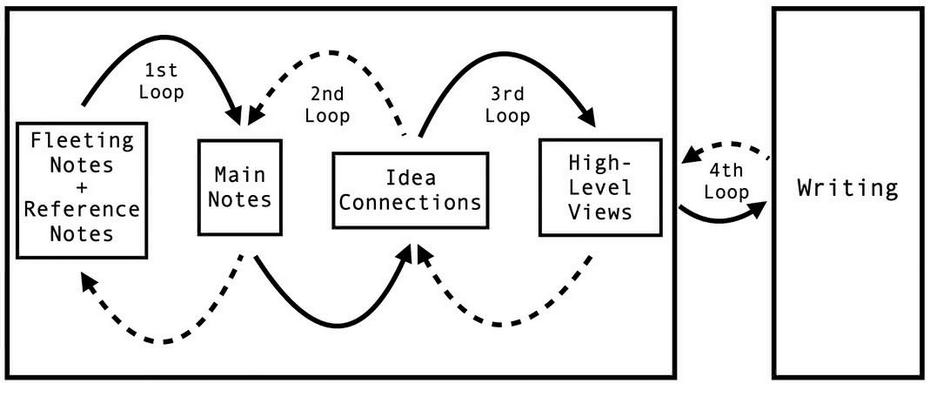
From A System for Writing by Bob Doto. While the diagram focuses on the Zettelkasten style of note-taking, the process can be easily adapted for other note styles.